The U.S. Marine Mammal Protection Act (MMPA) plays a critical role in regulating seafood imports into the United States. Under the MMPA Import Provisions, exporting countries must demonstrate that their fisheries management systems are comparable in effectiveness to U.S. standards in preventing the incidental killing or serious injury of marine mammals.
For Vietnam — one of the world’s leading seafood exporters — MMPA compliance directly affects market access to the United States, especially for tuna, pelagic fish, squid, and demersal fisheries. In 2025, the U.S. National Marine Fisheries Service (NMFS) issued its Final Comparability Finding Report for Vietnam, outlining both progress and remaining gaps.
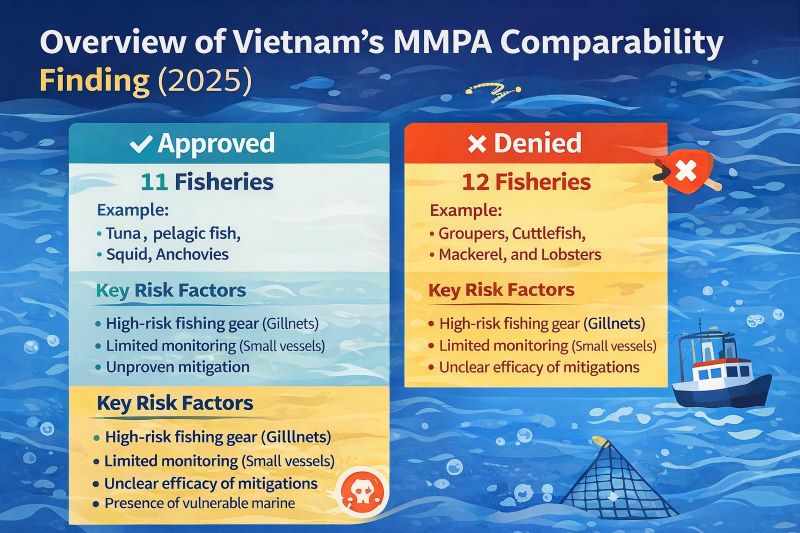
According to the NMFS final report, Vietnam received a partial comparability finding:
Some export fisheries were approved as comparable
Several fisheries were denied comparability
Key concerns remain around bycatch monitoring and mitigation
NMFS determined that 11 export fisheries were comparable in effectiveness to U.S. regulations, including selected fisheries targeting:
Tuna (handline and pole-and-line)
Anchovies and small pelagics (purse seine)
Octopus (pots)
Squid (handline, purse seine, trawl)
These fisheries demonstrated lower marine mammal interaction risk or had acceptable monitoring mechanisms in place.
NMFS denied comparability for 12 export fisheries, primarily involving:
Gillnets and entangling nets
Trawls and mixed-gear fisheries
Demersal and pelagic multi-species fisheries
High-risk fishing gear
Gillnets pose a significant entanglement risk to small cetaceans.
Insufficient bycatch monitoring
Vessels under 12 meters are not required to use logbooks.
Observer coverage is limited (often 1–5%).
Unclear mitigation effectiveness
Vietnam listed mitigation measures but did not provide evidence of effectiveness on a fishery-by-fishery basis.
Presence of vulnerable marine mammal stocks
Including Irrawaddy dolphins, classified as high-risk under 16 U.S.C. §1387(f)(3).
Vietnam has made notable progress in strengthening its legal framework:
Decree 26/2019/ND-CP, amended by Decree 37/2024/ND-CP, strictly prohibits the intentional exploitation of endangered marine mammals.
Marine mammals are listed under Group I – endangered, precious, and rare aquatic species.
Violations may result in criminal prosecution under Article 244 of the Penal Code.
These legal protections satisfy the MMPA requirement prohibiting intentional killing of marine mammals during fishing operations.
Vietnam employs a combination of:
Onboard observer programs
Fishing logbooks
Port inspections
Fisher interviews
However, NMFS found the system only partially compliant.
| Monitoring Method | Coverage |
|---|---|
| Logbooks | 75–100% (vessels ≥12m) |
| Observers | ~1–5% of trips |
| Port inspections | 100% for vessels ≥24m |
| Small vessels (<12m) | No mandatory reporting |
This gap is critical, as small gillnet vessels are among the highest risk for marine mammal bycatch.
Vietnam reported several mitigation efforts:
Development of Dolphin Deterrent Devices (DDD)
Fisher education and awareness programs
A long-term plan to phase out ~300 tuna drift gillnet vessels
Restrictions on licensing high-impact gear
However, NMFS concluded that:
Installation of DDDs is not mandatory
Effectiveness data is insufficient
No official bycatch limits have been established for vulnerable species
As a result, mitigation outcomes remain uncertain under MMPA standards.
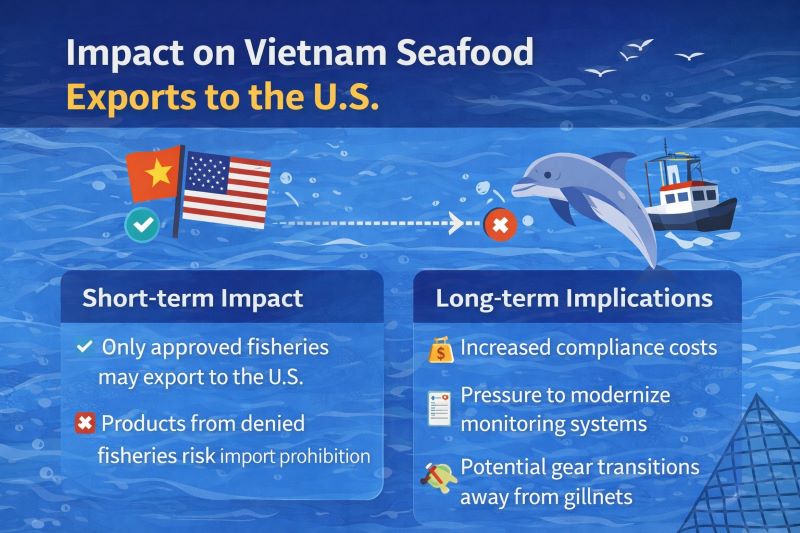
Only approved fisheries may export to the U.S.
Products from denied fisheries risk import prohibition.
Increased compliance costs
Pressure to modernize monitoring systems
Potential gear transitions away from gillnets
However, Vietnam’s proactive engagement with NMFS and policy reforms suggest continued improvement and future approvals.
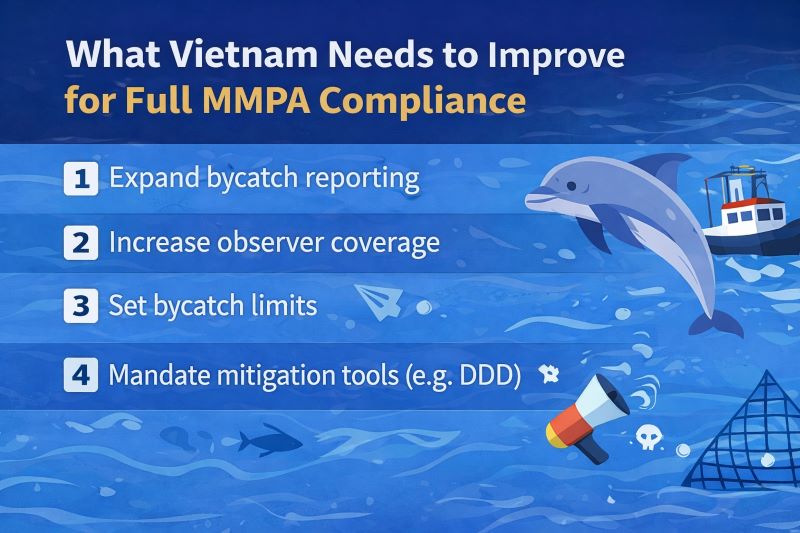
To achieve broader MMPA approval, Vietnam should focus on:
Expanding mandatory bycatch reporting to all vessel sizes
Increasing observer coverage in high-risk fisheries
Establishing science-based bycatch limits
Mandating and documenting mitigation tools (e.g., DDDs)
Aligning RFMO implementation (e.g., WCPFC measures)
U.S. NOAA Fisheries – MMPA Import Provisions
https://www.fisheries.noaa.gov/international/marine-mammal-protection-act
FAO – Responsible Fisheries and Bycatch Reduction
https://www.fao.org/fishery/en
Western and Central Pacific Fisheries Commission (WCPFC)
https://www.wcpfc.int
Vietnam is partially compliant. Some export fisheries are approved, while others remain restricted due to bycatch risks and monitoring gaps.
Gillnets have a high risk of entangling marine mammals, especially dolphins, and often lack adequate monitoring.
Yes, but only from fisheries that received a comparability finding from NMFS.
Irrawaddy dolphins, Indo-Pacific finless porpoises, and several dolphin species are considered high-risk.
With stronger monitoring, mandatory mitigation, and bycatch limits, Vietnam has a strong chance of expanding approval.


